

Why condition? PA6 · PA66
Conditioning polyamide: from a chance moisture condition to a defined one.
After injection moulding, PA6 and PA66 parts absorb moisture from their surroundings – and their toughness, stiffness and dimensions change as they do. Without targeted conditioning, the shop-floor climate decides what condition a part is in when it reaches assembly, testing or your customer. With conditioning, you decide.
Booking page in German. Prefer English? Use the enquiry form.
- Controlled moisture uptake in polyamide since 1996
- Four processes plus custom solutions
- Own systems and contract conditioning
Molecular level · schematic
What happens in the material
- 01Dry: chains bonded to each other
- 02Water binds to the amide groups
- 03Chains become more mobile
- Polymer chain
- Amide group
- Water molecule
- Hydrogen bond
01 Moisture condition
Moisture absorption in polyamide changes its properties – in both directions.
Water molecules bind to the amide groups of the polymer chains and make them more mobile. The material becomes tougher and more ductile, but also less stiff, and it swells slightly. Whether that helps or harms depends on what your part has to do.
How properties shift with moisture content
Direction, not magnitude
- Toughness, impact strength rises
- Elongation at break rises
- Stiffness (modulus) falls
- Strength falls
- Volume and dimensions (swelling) increase
- Glass transition temperaturethe temperature below which the amorphous regions are hard and glassy – not the melting point falls
Straight after moulding the part is almost dry: stiff and strong, but less ductile. Thin-walled functional features are at their most sensitive to bending during assembly in this condition.
As moisture content rises, the matrix becomes more mobile: toughness and ductility increase, stiffness and strength decrease, and the part swells slightly.
With high moisture uptake the trend continues. More is not automatically better: stiffness and dimensions can then deviate too far for the application.
Schematic: shows the direction of change only, not measured values. The extent depends on the grade, fillers and additives – the data sheet of the grade you use is decisive.
The right condition is not “as moist as possible”. It is the one your application needs – for example enough toughness to assemble a snap-fit without losing the stiffness of a load-bearing area.
-
PA6 and PA66 behave differently
PA6 can absorb more moisture than PA66 and releases it more readily. Target condition and duration therefore cannot simply be transferred from one grade to another.
-
A moisture value needs its reference basis
Glass fibres absorb practically no water. With PA-GF, part moisture content and matrix moisture content therefore differ noticeably – a percentage without a reference basis cannot be compared.
Assessing moisture in glass-fibre-reinforced polyamide -
Not every engineering plastic behaves like polyamide
Polyamides are the most common case. Other engineering plastics absorb considerably less moisture or are barely hygroscopic. Whether conditioning makes sense is assessed for each material – not transferred.
02 Challenges in practice
An unsuitable moisture condition rarely shows up at the moulding machine. It shows up in assembly, testing or at your customer’s.
The causes are often only found after a detour, because material and design are not at fault. Five patterns we see time and again – each one can have other causes, too.
-
Assembly
Clips and snap-fits crack during joining
Dry polyamide is stiffer and less ductile. Thin-walled functional features can then crack during assembly – even though material and design are right.
Typical sign: failures cluster in fresh parts and shortly after production
-
Dimensions
Dimensions change after inspection
As it absorbs moisture, the part swells. If it is measured dry as moulded, it can have different dimensions at your customer’s than in the inspection report.
-
Consistency
Same part, different behaviour
How much moisture a part absorbs in storage depends on the shop-floor climate, season and storage time. Batches from summer and winter then do not behave in the same way.
-
Quality assurance
Test results cannot be compared
Mechanical and dimensional tests depend on the moisture condition. Material testing therefore conditions specimens to a defined condition first, for example to ISO 1110. Without a defined condition, you are comparing results from different starting points.
-
Makeshift methods
Makeshift methods create new problems
Wetting parts with water in bags or under uncontrolled conditions does not produce a reproducible condition. Local over- or under-moistening, stains or distortion are possible.
Why not just store the parts?
Moisture uptake by diffusion – the time required rises disproportionately with increasing wall thickness.
In the idealised model of a flat plate, doubling the wall thickness means roughly four times the time to reach the same share of the final uptake. How long a specific part actually takes also depends on the material, geometry, initial moisture content, target condition and process. In passive storage, the fluctuating shop-floor climate adds to this: the condition develops at some point – but not in a defined way.
How long does polyamide need to be conditioned?Wall thickness 1 ×
time ≈ 1 ×
Wall thickness 2 ×
time ≈ 4 ×
03 Benefits of defined conditioning
Defined conditioning means: you set the condition – not the storage climate.
The difference lies not in the material but in the point in time: with targeted conditioning, the part reaches its target condition before the step that needs it.
Without targeted conditioning
- Mouldingdry
- Storage, transportdepends on climate
- Assemblyundefined
- Testingundefined
- Delivery, usestill developing
With defined conditioning
- Mouldingdry
- Conditioningtarget condition reached
- Assemblydefined
- Testingdefined
- Delivery, usedefined*
What it achieves
-
01
A reproducible starting condition
Process parameters instead of the storage climate determine the condition before the next step – regardless of season and storage time.
-
02
Reliable assembly
Clips, snap-fits and integral hinges can be given the toughness that joining demands – when the target condition is designed for them.
-
03
A plannable process step
A defined step with a duration determined for your part replaces open-ended storage time – which helps logistics and delivery planning.
-
04
Verifiable for QA and customers
A target condition can be specified and checked – the basis for approvals and customer requirements. For contract conditioning, documentation for your QA is available on request.
Specifying the target condition
“Conditioned” is not a specification.
A percentage on its own says little. A verifiable target condition contains six details – and is set for the function-critical areas, not just as an average.
- 01
- Target valuemoisture content to be reached
- 02
- Reference basispart or matrix moisture content
- 03
- Tolerancepermitted range
- 04
- Measuring methode.g. weighing against dry mass
- 05
- Test climateconditions during measurement
- 06
- Critical areaswhere the condition must be reached
04 Conditioning processes
Four processes and custom solutions. The choice follows the part – not the other way round.
No process is the best one for every task. That is why we offer several – and choose together with you, based on the criteria that apply to your part.
-
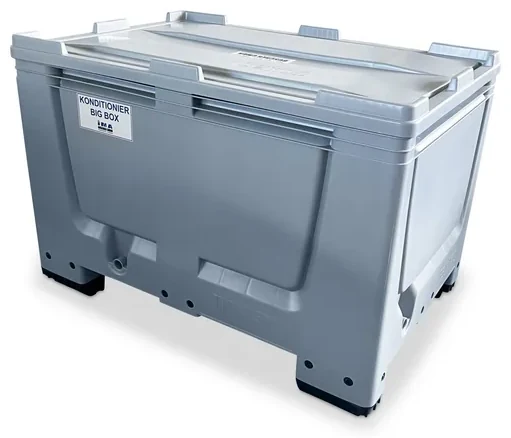
01
No-Energy
Moisture uptake at ambient temperature in a closed, specifically humidified atmosphere – during storage or transport time, without heating.
Suitable when time is available anyway, for example in buffer storage or in transit.
e.g. BIG BOX · KS 1300 · conditioning container
-
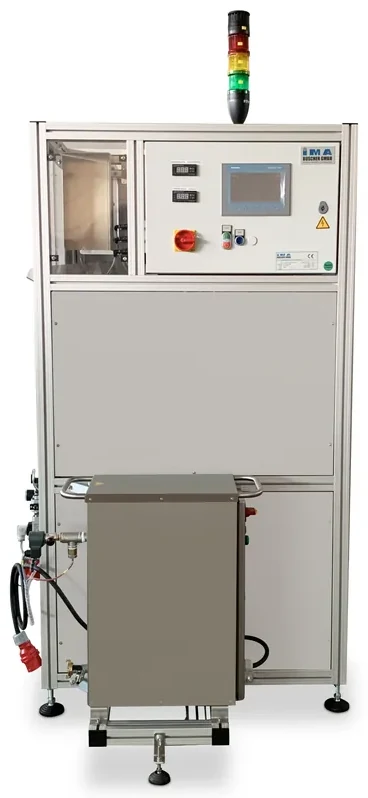
02
Saturated steam
Conditioning under slight steam pressure – cycled and close to the moulding machine.
Suitable for high volumes and automated conditioning processes.
e.g. JK 6/14 · JK 1/23 · JK 1/14
-
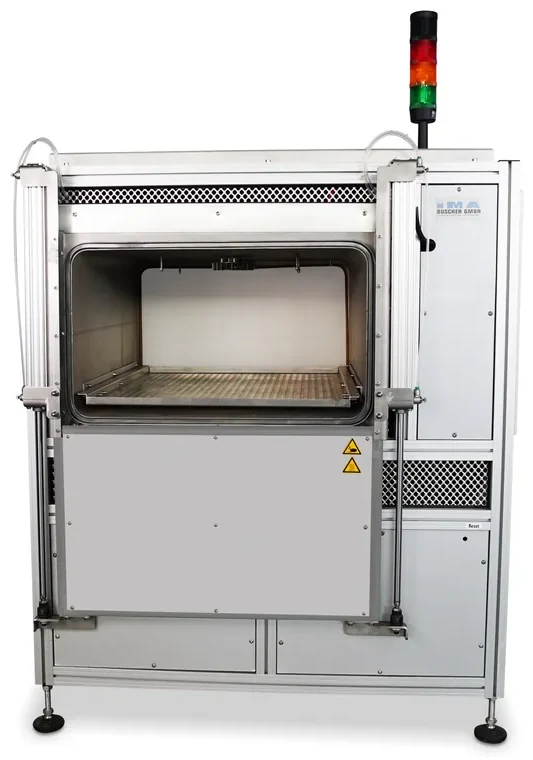
03
Vacuum
Lowering the pressure in the vessel for an even moisture uptake.
Suitable for parts with complex geometries and specific process control requirements.
e.g. JK 1/240 · JK 1/145 modules
-
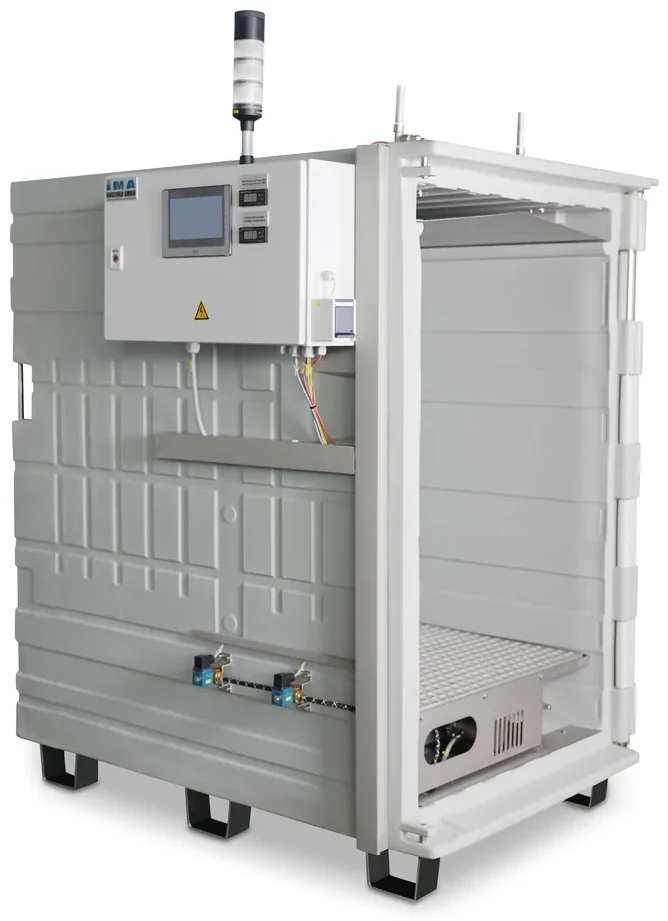
04
Steam atmosphere
Parts stay in their small load carriers, Euro boxes or mesh boxes and are exposed to a steam atmosphere in a closed chamber – optionally with drying.
Suitable when large batches are to be conditioned with little handling.
e.g. KS 1300 D · KS 1300 TD · conditioning container D
-
Custom solution
Water bath
Moisture uptake by storing the parts in water. An established process which we implement as a custom solution where a customer specifically requires it.
Worth noting storage in water can lead all the way to saturation – define the target condition and reference basis in advance.
Custom-built systems
Process names and descriptions as on condisystems.com. Example systems only – the complete range and technical data are on the system pages.
All conditioning systems05 Applications
Where controlled conditioning matters. Typical tasks from practice.
Conditioning is relevant wherever the condition of a polyamide part on a particular date matters – not in an industry as such.
- 01
Assembly-critical features
Clips, snap-fits and integral hinges that are joined shortly after production.
- 02
Dimensional and fit requirements
Parts whose dimensions must be right in the condition in which they are used.
- 03
Series launch with a delivery requirement
A customer specifies a defined delivery condition.
- 04
Testing and approval
Initial samples and tests are to be carried out in a defined condition.
- 05
Brittle or broken parts
Complaints in which the moisture condition is a possible cause.
- 06
Capacity bottlenecks
Demand temporarily exceeds your own conditioning capacity.
For manufacturers in
- Injection moulding and plastics processing
- Automotive supply
- Electrical and electronics
- Technical plastic parts
Companies that work with us






A selection of our customers.
06 Your route
Your next step. Four routes – depending on where you stand.
You do not need to decide straight away whether you need your own system. Many projects start with a specific question or a quick self-assessment.
What best describes your situation?
-
Matches your situation
Your own conditioning system
For series production with ongoing demand. Systems for all four processes – from a conditioning cabinet to an automated solution at the machine.
-
Matches your situation
Contract conditioning
We condition your parts using the process intended for the application – for a single project or on a recurring basis, with documentation for your QA on request.
-
Matches your situation
Individual consultation
You tell us the material, part and target condition – we assess which process is suitable and how long conditioning is likely to take.
Booking page in German.
-
Matches your situation
CondiCheck
Free online self-assessment: 10 questions, a CondiScore out of 100 in five categories and your top 3 areas for improvement by email. A first orientation, not a technical assessment.
Prefer to read up first? Technical articles on the knowledge platform
07 Frequently asked questions
Short answers to frequent questions.
Your question is not listed? Ask us directly
Does every polyamide part need to be conditioned?
No. Whether and how far depends on the condition the function-critical areas need at assembly, testing or delivery. Some parts reach it in time without targeted conditioning, others do not.
How long does it take to condition PA6 or PA66?
There is no general figure. The duration depends on the material including fillers and additives, wall thickness and geometry, initial moisture content, target condition and process. We assess it for your part.
Technical article on conditioning timeIs conditioning the same as drying or annealing?
No. Conditioning is a controlled uptake of moisture. Drying removes moisture, for example from pellets before moulding. Annealing is a heat treatment to relieve internal stresses; after annealing, parts have to be conditioned again.
Which plastics besides polyamide are suitable?
Conditioning is mainly used for polyamides, including glass-fibre-reinforced grades. Contract conditioning also covers other suitable hygroscopic engineering plastics. Many engineering plastics absorb considerably less moisture, so we assess the benefit for each material.
Does the moisture stay in the part permanently?
No, the process is reversible. In dry surroundings the part releases moisture again. Storage, packaging and transport after conditioning should therefore be planned as well.
How is the moisture content determined?
Frequently by weighing: the weight gain relative to the dry mass. It shows the total amount of water absorbed – not how it is distributed within the part. For a specification, target value, reference basis, tolerance, measuring method and test climate belong together.
Moisture content and measurement in the guideYour application
The quickest way to an assessment: five details about your part.
If you do not have all the details yet, the conversation is still worthwhile – clarifying them is part of our job.
Useful for your enquiry
- Materiale.g. PA6-GF30, including additives
- Partwall thickness, functional features, drawing or photo
- Target conditionif known, with reference basis and tolerance
- Volume and cycleparts per day or per batch
- Point in timewhen the condition must be reached: assembly, testing or delivery