Conditioning time of polyamide (PA6, PA66): influencing factors, methods and practical guidelines
The conditioning of polyamide is a crucial process step for establishing defined mechanical and dimensional properties of plastic components.
However, in industrial practice, it repeatedly becomes apparent that the required conditioning time is frequently misjudged. Blanket time specifications or transferred empirical values not infrequently lead to unstable processes, quality fluctuations, and increased scrap rates.
The central challenge is to view conditioning not as a mere time quantity, but as material, geometry and process-dependent process to understand.
This article provides a structured overview of the key influencing factors, typical conditioning processes and practical guide values for conditioning PA6 and PA66.
Why conditioning time is crucial for polyamide processing
Polyamide are considered hygroscopic plastics. This means that the material absorbs moisture from its surroundings, and this significantly influences its mechanical behaviour.
An inadequately conditioned state can lead to the following effects:
- Reduced impact strength
- increased brittleness
- dimensional variations in later use
- Changed long-term behaviour under load
- increased complaint rates
The aim of conditioning is therefore not compliance with a specific time, but the establishment of a defined moisture content in the building component.
Depending on the application and material, typical target ranges are often around 1.5 % bis 2.5 %.
Influencing factors on the conditioning time of polyamide
The required conditioning time results from the interplay of several physical and material-specific influencing factors. In practice, it has been shown that the following factors in particular are of crucial importance for the duration and quality of conditioning.
Different types of polyamide, as well as modified compounds, exhibit significantly different moisture absorption behaviour.
While unreinforced materials absorb moisture comparatively homogeneously, additives have a considerable influence on diffusion within the material.
Particularly relevant are:
- Fibre reinforcements
- Mineral fillers
- Fire protection systems
Flame retardant additives can significantly slow down moisture uptake, as they partly act as a barrier within the molecular structure, making moisture transport more difficult.
Wall thickness is one of the most crucial influencing factors on conditioning time.
Moisture is absorbed via diffusion processes from the outside to the inside. This means that
- Thin-walled components reach a homogeneous moisture state faster.
- Thick-walled components require significantly longer because the moisture needs to penetrate into the core.
It should be noted that the time does not increase linearly with wall thickness, but increases disproportionately.
In practice, this often means that components appear to be „conditioned“ on the outside, while the core is still significantly too dry.
This can lead to internal stresses, subsequent dimensional changes, or unstable component behaviour.
The geometry of a component significantly influences the effective exchange surface for moisture.
The key influencing factors are:
- Surface area to volume ratio
- ribbed or structured geometries
- Smooth, compact components
Components with a high surface structure (e.g. finned parts) allow for significantly faster moisture absorption, as more active surface area is available.
In contrast, massive or geometrically compact components react much more slowly.
This effect is often underestimated in practice and leads to incorrect assessments of the required conditioning time.
The initial moisture content of a component has a direct influence on the necessary conditioning duration.
Freshly produced injection-moulded parts are usually very dry and often have moisture content in the range of less than 0.3 %.
Stored components, on the other hand, may have an increased moisture content.
The larger the difference between initial moisture and the target value, the longer the conditioning process will take.
In practice, this means:
- very dry parts → longer processing times
- pre-aged or stored parts → shortened times
The target value of the conditioning significantly determines the required process duration.
A component that only requires slight pre-conditioning needs significantly less time than a component that must be adjusted to a precisely defined moisture range.
Typical target values frequently lie – depending on the application and material – in the range of approximately 1.5 % bis 2.5 %.
The higher the target moisture content, the longer the conditioning takes, as the moisture needs to penetrate deeper into the material.
Temperature is a central parameter for controlling the rate of moisture absorption.
As the temperature rises, the mobility of the molecular chains in the material increases, which significantly accelerates the diffusion of moisture.
Higher temperatures therefore lead to shorter conditioning times.
However, controlled process management is crucial in this regard:
- Too low temperatures → very long process times
- Excessively high or uneven temperatures → inhomogeneous results
In addition, the consistency of the process conditions plays an important role. Temperature and humidity distribution within the system must be as homogeneous as possible in order to achieve reproducible results.
The conditioning method employed is the biggest influencing factor on the actual process duration in practice.
Different procedures offer widely varying possibilities in terms of:
- Moisture uptake rate
- Uniformity of conditioning
- Process stability
- Integration into existing production processes
While climatic procedures allow for very controlled but slow conditioning, water- or steam-based procedures offer significantly faster results.
In particular, steam conditioning, through the combination of temperature and high humidity, enables a significant acceleration of the process with good reproducibility.
The selection of the appropriate process should therefore always take into account the component, material, number of pieces, and process requirements.
Industrial comparison of conditioning processes
The choice of the appropriate conditioning method has a decisive influence on the process duration, the uniformity of moisture distribution, and the economic efficiency of the overall process.
In industrial practice, different processes have become established which vary significantly in terms of process control, speed, and energy consumption.
The following compares the essential conditioning methods.
No-energy conditioning
The no-energy conditioning is based on passive humidity generation without external energy input. The moisture is introduced into the environment via special humidification systems and absorbed by the component.
Characteristics
- No external energy required for moisture generation
- very energy efficient
- simple and robust process control
Due to the lack of active temperature support, moisture absorption is comparatively slow.
This method is particularly suitable for applications where energy saving is a priority and longer conditioning times are acceptable.
Dampfatmosphäre (klassische Dampfkonditionierung)
In steam atmosphere conditioning, the component is exposed to an environment with near-saturated humidity and elevated temperature.
Characteristics
- accelerated moisture absorption through a combination of temperature and humidity
- Good uniformity with suitable loading
- Industrial applicability
Compared to purely passive methods, the processing time can be significantly reduced.
At the same time, continuous energy input is required to generate and maintain the steam atmosphere.
This procedure represents a good compromise between process speed and technical feasibility in many applications.
Steam pressure rinsing process (e.g. rotary machines like JK 6/14)
In the steam purging process, components are subjected to steam in a targeted and repeated manner. The moisture absorption is significantly accelerated by the cyclic process and the use of pressure or intensive steam flow.
Characteristics
- very fast conditioning
- high process dynamics
- good penetration even with more complex geometries
By targeted loading of the components, a significantly reduced conditioning time achieved, particularly in comparison to static methods.
This procedure is particularly suitable for high-throughput applications and clearly defined process times.
Vacuum conditioning
Vacuum conditioning involves treating the component under reduced pressure first, which removes trapped air. Moisture is then introduced, allowing it to penetrate the material more efficiently.
Characteristics
- improved component penetration
- suitable for complex or thick-walled geometries
- technically more demanding procedural management
Moisture absorption can be specifically supported by the vacuum, particularly in components with limited diffusion.
The equipment involved and the energy required are generally higher, which is why this method is primarily used for specialised applications.
Design of conditioning – focus on critical component areas
In the practical design of conditioning processes, it is not expedient to design the entire component for a uniform moisture content.
Crucial are the critical functional areas, such as:
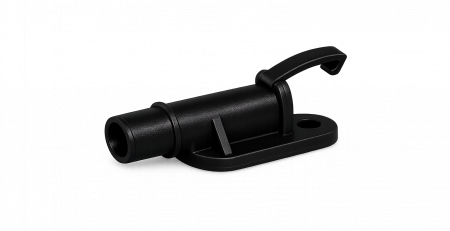
- Clips
- Film hinges
- Nose ring
These areas generally have thinner walls and absorb moisture much faster than solid component areas.
Practical implication
If the entire component is conditioned to a target value of 2.0 %, for example, this can result in thin-walled areas already achieving significantly higher moisture contents.
Full conditioning of the entire component is therefore often unnecessary.
Aim in practice
Crucially, the critical areas must reliably fulfil their function:
- Sufficient flexibility in clips and film hinges
- No breakage during assembly or stress
- No white cracking in the functional area
Once this condition is met, the conditioning is functionally correct, regardless of the moisture content in the rest of the component.
Conclusion – conditioning time is not a fixed value
The conditioning time of polyamide is not a fixed parameter, but the result of the material, geometry and process.
A purely time-based consideration often leads to inefficient or unstable processes in practice.
Crucially, the targeted setting of a functional moisture content, which reliably meets the component's requirements.
We will support you with the technical assessment and show you which process is the best solution for your application.
Frequently asked questions
How long does PA6 need to be conditioned for?
The conditioning time of PA6 depends heavily on the component geometry, surface, wall thickness and the process used. In practice, the range is from a few hours to several days. The crucial factor is achieving a defined and homogeneous moisture content in the component.
Does PA66 differ in conditioning?
Yes. PA66 generally absorbs moisture more slowly than PA6, and therefore requires adjusted conditioning times. This difference is particularly noticeable with thick-walled or reinforced components.
What is the influence of additives such as flame retardants?
Flame retardant additives can significantly slow down moisture absorption. They influence diffusion within the molecular structure and hinder moisture penetration. As a result, the required conditioning time is extended in many cases.
What is the most efficient conditioning method?
The efficiency depends on the application, component and objective. In many industrial applications, steam-based processes – particularly dynamic processes such as steam-pressure purging – offer the best combination of speed, process stability, and reproducibility.
How does conditioning behave with high-performance polymers like PPS or PPA?
High-performance polymers like PPS (polyphenylene sulphide) or PPA (polyphthalamide) differ significantly from conventional polyamides.
- PPS exhibits very low moisture absorption and generally does not require conventional conditioning to adjust mechanical properties.
- Power purchasing agreement in contrast, depending on the type and application, it can absorb moisture, but to a significantly lesser extent than PA6 or PA66.
In practice, this means:
- PPS → usually no conditioning required
- PPA → targeted conditioning can be useful, but with different process parameters
A direct transfer of conditioning processes from polyamide processing is not conducive here.