Why component moisture and matrix moisture are not identical
A component made of glass-fibre-reinforced polyamide is to be conditioned to 1.5 % moisture content. The target value is defined; the increase in weight is monitored, and once the value has been reached, the process is deemed complete.
But what exactly do these 1.5 % refer to?
Does this apply to the entire component including the glass fibres? Or exclusively to the polyamide matrix, which absorbs moisture and develops its essential effect?
This distinction is crucial for the appropriate assessment of a conditioning process. This is because, in the case of glassfibre-reinforced polyamides, the moisture content of the entire component and the calculated moisture content of the polymer matrix are not identical.
A moisture content is only unambiguous if its reference basis is also clearly defined.
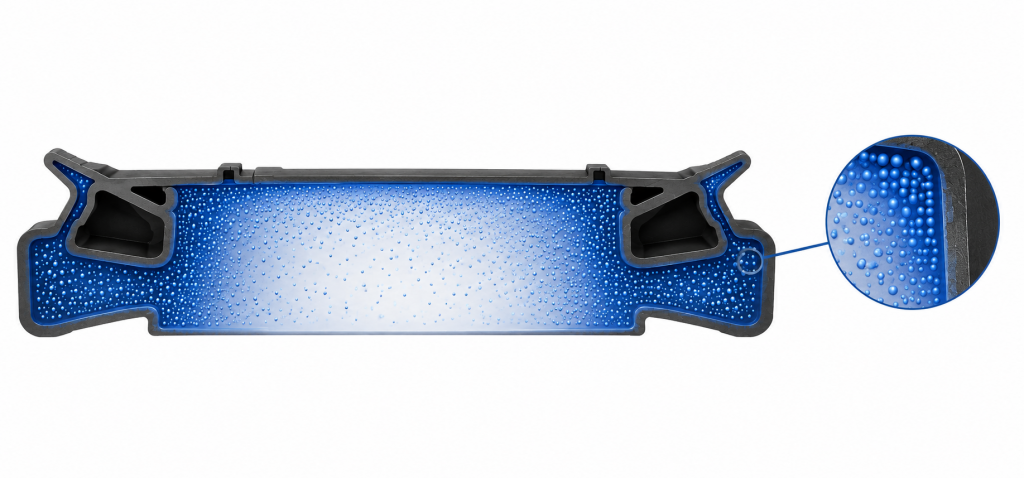
1.5 % Moisture – relative to what?
A PA-GF30 component consists, in simplified terms, of:
70 % polyamide matrix
and
30 % fibre-optic cables
The glass fibres contribute to the overall weight of the component. The moisture absorption relevant to conditioning, in contrast, essentially takes place in the polyamide matrix.
Consequently, a component may have a total moisture content of 1.5 %, whilst the calculated moisture content of the polyamide matrix is significantly higher.
Why fibre optics are changing the valuation
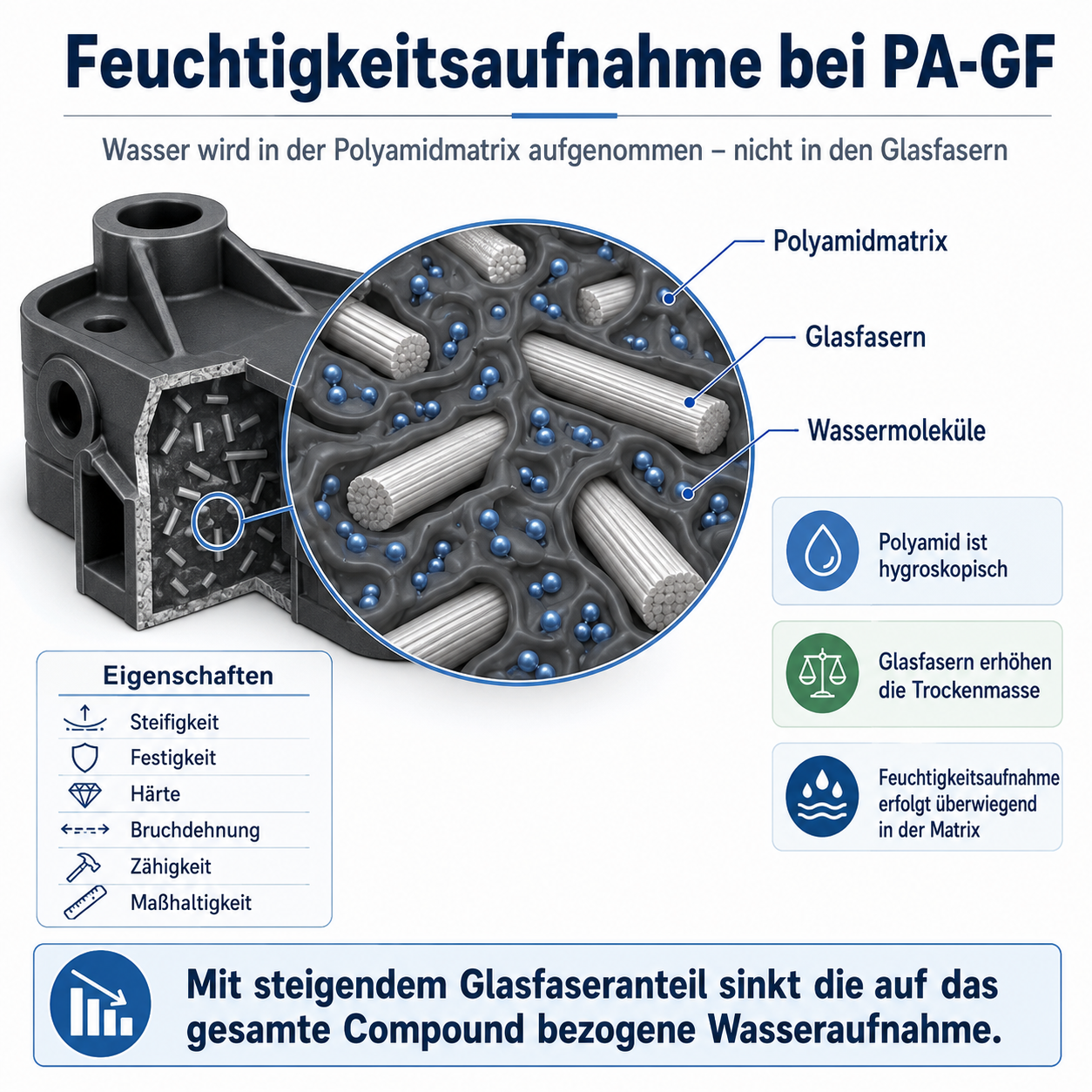
Polyamides are hygroscopic plastics. They absorb moisture from water or humid ambient air. The stored water molecules influence the interactions between the polymer chains and act as a plasticiser within the polyamide matrix.
This allows, among other things, the following properties to change:
- Stiffness
- Strength
- Hardness
- Elongation at break
- Toughness
- Dimensional accuracy
In the case of glass fibre-reinforced polyamides, however, the component does not consist exclusively of the water-absorbing polymer matrix. Part of the dry total mass is formed by the glass fibres.
In a gravimetric analysis, the glass fibres are weighed in their entirety, but they contribute virtually nothing to the moisture absorption relevant to conditioning. This takes place mainly in the polyamide matrix.
As the proportion of glass fibre increases, the water absorption related to the entire compound typically decreases.
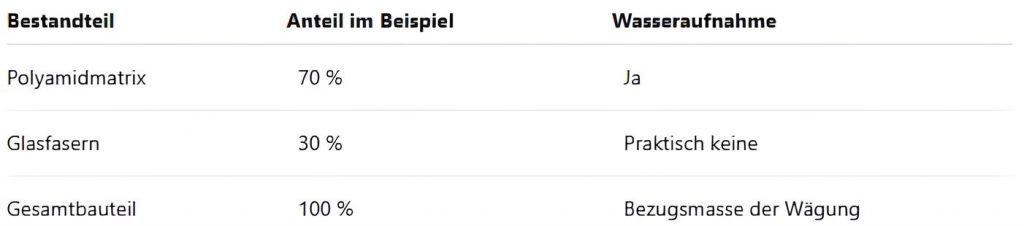
The glass fibres increase the dry total mass of the component without absorbing moisture to a comparable extent.
This is precisely where the difference between component moisture and matrix moisture arises.
Building moisture and matrix moisture distinguish
Building moisture
Calculated matrix humidity
Building component moisture describes the absorbed water mass relative to the entire dry initial mass of the building component.
This starting material includes:
- the polyamide matrix,
- the glass fibres,
- Additives and other components.
Building component moisture = absorbed water mass ÷ dry total mass × 100
During a gravimetric check, this parameter is determined by the weight gain of the entire component.
The calculated matrix moisture describes the absorbed mass of water solely in relation to the dry mass of the polyamide matrix.
Matrix moisture = absorbed water mass ÷ dry mass of the polyamide matrix × 100
The addition „theoretically“ is important:
The moisture content of the matrix is not measured separately during a standard weighing. It is derived from the overall weight increase and the known matrix proportion.
The weight gain of the entire component is measured. The moisture of the polyamide matrix is then derived arithmetically.
Calculation example: PA-GF30
Let's consider a simplified PA-GF30 component with a dry total mass of 1,000 grams.
After conditioning, the component weighs 1.015 grams.
Therefore, it has 15 grams of water recorded.
Step 1: Calculate component moisture
Step 2: Determine matrix moisture
15 g water ÷ 1,000 g total dry mass × 100
Result:
1.50 % Component moisture content
The recorded 15 grams of water are now exclusively related to the 700 gram polyamide matrix:
15 g water ÷ 700 g dry polyamide matrix × 100
Result:
2.14 % calculated matrix moisture content
Result:
| Considered reference mass | Moisture content |
|---|---|
|
Entire PA-GF30 component |
1,50% |
|
Polyamide matrix |
2,14% |
Both values are arithmetically correct. They simply refer to different masses.
Manufacturer data show the influence of the glass fibre content
The fundamental relationship can also be seen from technical material data. BASF specifies the following equilibrium moisture contents for selected PA6 materials at 23 °C and 50 percent relative humidity:
| Material example | Reinforcement | Equilibrium moisture |
|---|---|---|
|
Ultramid B3S |
unreinforced |
2,6-3,4% |
|
Ultramid B3EG6 |
30% optical fibres |
1,9-2,3% |
|
Ultramid B3WG10 |
50% optical fibres |
1,3-1,7% |
As the proportion of fibreglass increases, the moisture absorption relative to the entire compound decreases in these examples.
For other commercial PA6-GF30 compounds, moisture absorption under defined standard conditions is also explicitly stated with reference to the respective overall compound. For example, DOMO states equilibrium moisture contents of approximately 2.2 to 2.4 percent at 23 °C and 50 percent relative humidity for various PA6-GF30 types.
Do not reduce existing target values!
The calculation example does not imply that an existing target value of 1.5 percent for PA-GF30 can generally be reduced to 1.05 percent.
If a requirement is explicitly defined as component or compound moisture and is substantiated by material data, customer requirements, or component tests, then that specific requirement is binding.
The necessary moisture content depends, among other things, on:
- the specific PA type and compound,
- the glass fibre and additive content,
- the component geometry and wall thickness,
- the required mechanical properties,
- in terms of dimensions,
- under later operating conditions,
- the moisture distribution in the component.
The calculation therefore does not serve to replace audited specifications. It helps to correctly question the meaning and origin of existing percentage values.
Where misinterpretations arise in practice
Unclear basis for reference
The specification is simply „1.5 percent moisture“. Whether the value refers to the entire compound or the polymer matrix is not documented.
Transmission of unamplified PA
A target value for unreinforced polyamide is transferred unchanged to a glass fibre-reinforced compound.
Same target value for different GF percentages
PA-GF15, PA-GF30 and PA-GF50 are rated based on the same percentage weight increase, although their matrix content is different.
Weight gain is equated with uniform distribution
The total weight achieved shows how much water the component has absorbed. However, it does not automatically prove that the moisture has already penetrated evenly into the core of the component.
Historically inherited specifications
A target value has been used for years, although its original derivation is no longer known and it has never been verified against the actual required component properties.
Potential for time, energy and costs
If a target value was set without a clear reference basis or adopted from another material, the conditioning process may run longer than technically necessary.
A professionally substantiated reassessment can therefore open up potential for:
Determine conditioning time as required
Reduce energy consumption
Increase plant capacity
Reduce process costs
The objective should not be to introduce as little moisture as possible into the component.
The technically correct target state is achieved when the required component properties are reproducibly present – without unnecessarily prolonging the process.
The time required to condition a polyamide component to the desired state depends on factors such as the material, wall thickness, temperature, and the process used, among others. You can find out more about this in our technical article. „How long does polyamide need to be conditioned for?“
So should target values be checked
Before an existing moisture specification is changed, the following questions should be answered:
- Is that specific compound uniquely known?
- What is the actual fibre and additive content?
- Does the target value refer to the component or the polymer matrix?
- What is the source of this requirement?
- Is the measurement procedure unambiguously documented?
- At what point is the component weighed?
- What mechanical and dimensional properties must be achieved?
- Were different moisture levels compared?
- Is the moisture distributed sufficiently throughout the functional area?
- How is the condition maintained after conditioning, storage, and transport?
Graduated conditioning tests are particularly informative. In these tests, components are subjected to different
They were subjected to different humidity levels and then tested on the basis of their relevant properties.
This makes it possible to determine which target range is technically necessary – and whether an existing process might be running for an unnecessarily long time.
A clear specification needs more than a percentage.
A robust conditioning specification should not simply state „Target humidity: 1.5 per cent“.
It is advisable to include at least the following details:
| Information | Example |
|---|---|
|
Material |
Specific trade name |
|
Component |
Article number and geometry |
|
Target value |
1.2 % Component moisture content |
|
Reference basis |
Dry total mass |
|
Tolerance |
for example, ± 0.3 percentage points |
|
Measurement method |
defined gravimetric procedure |
|
Test date |
at a specified settlement time |
|
Proof of property |
Functional, impact or dimensional testing |
This ensures that production, quality assurance, the customer and the supplier actually interpret the same value in the same way.
The target value and the method go hand in hand
A correctly defined target value will only lead to a reproducible result if the conditioning process is also properly controlled.
Temperature, available moisture, component arrangement, loading, wall thickness and process duration all influence both the rate of water absorption and the distribution of moisture within the component.
We explain the differences between the various methods in this article „Steam conditioning vs. water bath“. We have also outlined the key benefits of controlled steam conditioning in the article „4 Benefits of Steam Conditioning“ In summary.
Conclusion:
In glass fibre-reinforced polyamides, component moisture and matrix moisture are not identical.
The glass fibres contribute to the dry total mass of the component, while the moisture is absorbed by the polyamide matrix. A component moisture content of 1.5 percent can therefore – depending on the reinforcement content – correspond to a significantly higher calculated matrix moisture content.
This does not mean that existing targets can be reduced across the board. It is crucial what a percentage value refers to, how it was determined, and which component properties are intended to be achieved with it.
However, if unclear or historically inherited targets are systematically reviewed, relevant potentials can emerge:
- shorter conditioning times,
- lower energy consumption,
- Higher plant capacity,
- lower legal costs,
- more precise quality specifications.
The crucial question therefore is not only:
How much moisture has the component absorbed?
But also:
What does this value refer to, and what properties are intended to be achieved with it?
Frequently asked questions
Do glass fibres absorb water during conditioning?
The moisture absorption relevant for conditioning takes place in the polyamide matrix. The glass fibres contribute to the mass of the compound without significantly participating in water absorption.
What does 1.5 percent moisture mean for PA-GF30?
That depends on the reference basis. If 1.5 percent is related to the total dry mass of the component, the simplified PA-GF30 example results in a calculated matrix moisture content of around 2.14 percent.
Can the target moisture content for PA-GF30 be easily reduced?
No. An adjustment may only be made once the reference basis for the previous target value has been clarified and it has been proven through tests that the required component properties can also be reliably achieved at a lower value.
Is the moisture content of the matrix measured directly by weighing?
No. The weighing first records the weight increase of the entire component. The matrix moisture content can then be calculated from this using the known matrix proportion.
Is the moisture evenly distributed immediately after conditioning?
Not necessarily. Particularly with thick-walled components, the overall weight increase may have already been reached, while a moisture gradient still exists between the surface and the component core.
Do PA6-GF30 and PA66-GF30 have the same target values?
No. The necessary target state is dependent on the specific type of polyamide, compound, reinforcement content, component, and the required properties. Manufacturer values and tested component specifications must therefore always be assessed on a material-specific basis.